Queen of Swords description and symbolism
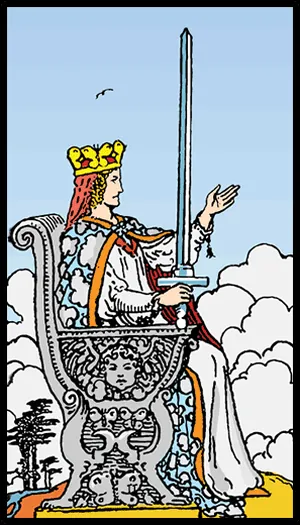
Shown in strict profile and facing right, a queen sits on a stone throne raised above a bank of clouds, a sword held perfectly upright in her right hand and her left hand lifted with the palm open, as if inviting someone to speak. The throne is carved with a winged cherub's head, a crescent moon and butterflies, and butterflies also crown her. Her cloak is patterned with clouds, and a red tassel hangs from her wrist. A single bird flies high in the clear upper sky, while below her the clouds are gathering. A few trees stand far off, bent slightly by wind.
Smith made this queen the only court figure whose sword is dead vertical, and the only queen who does not look at the viewer. She has seen enough. The clouds beneath the throne are the weather she has already lived through; tradition links her with sorrow, widowhood, and the clarity that follows loss. The open hand matters as much as the blade: she will hear you out, and then she will tell you the truth. Water of Air is feeling filtered through intellect, which is why she is perceptive without being sentimental.
The Queen of Swords is honesty with experience behind it: independent, direct, unfooled, and fair, the person who tells you what nobody else will.
Queen of Swords upright meaning
When the Queen of Swords appears upright, the reading asks for clarity above comfort. As a person, she is the mentor who gives honest feedback, the friend who notices the lie before you do, the attorney, editor, judge or senior manager who cuts through the noise in a single question. She has usually been through something hard and come out of it wiser rather than softer. She values truth, her own company, and the right to decide for herself. If she represents you, the card says your judgment is sound and your instinct to set a boundary is correct.
Her advice is to see the situation as it is, not as you wish it were, and to speak to it plainly. Sentiment is not banned; it is simply not allowed to run the decision. She also reminds you that the open hand comes first: listen fully, then rule. Beside the Hierophant, her clarity carries institutional weight and the verdict is final. Beside the Three of Swords, she is the person who has grieved and knows exactly what you are feeling. Beside the King of Swords, the pair is the clearest mind in the deck, and the matter at hand will be judged on its merits.
Queen of Swords reversed meaning
The Queen of Swords reversed keeps the blade and drops the open hand. She becomes cold, cutting, sarcastic, and merciless in judgment; honesty curdles into cruelty and independence into isolation. As someone in your life, she may be a critic who cannot be pleased, an ex who still gets a dig in, or a parent whose love comes wrapped in evaluation. Her sharpness is still intelligent, which is what makes it hard to dismiss.
Inward, the reversal often describes grief that has hardened. Something hurt, and the response was to build a tower of logic nobody can reach. The person stops feeling in order to stop hurting, decides everyone has a motive, and calls the resulting loneliness strength. It can also be the opposite failure: a mind so clouded by emotion that it cannot see straight at all, bitterness replacing the clarity she is known for. The repair is to let the clouds under the throne be weather you passed through rather than the air you breathe. Next to the Five of Cups, the bitterness has a specific loss behind it. Next to the Star, the thaw is possible and the honesty becomes gentle again.
Queen of Swords in love and as feelings
Love under the Queen of Swords is honest, independent, and slower to warm than other cards. She describes a partner who needs her own space and respects yours, who says what she means, and who will not pretend. Couples pull her when a hard conversation is needed and when one person has to stop sugarcoating. She also appears for people who have been hurt before and are deciding, carefully, whether to open the gate again. Love with this queen is real once it is given; it is just not given quickly.
As feelings, the Queen of Swords means the person is weighing you with a clear head. They may admire you and find you interesting, and they are also watching for inconsistency; they want the truth more than they want flattery. There can be a reserve that reads as coldness but is really caution, often from a past relationship that ended in grief. Reversed, she warns of a partner who punishes with silence or sarcasm, or of your own bitterness closing a door someone was trying to open. For singles, the advice is to stop apologizing for your standards; the right person will meet them. With the Two of Cups alongside, the reserve melts into a relationship built on mutual respect.
Queen of Swords in career and money
At work, the Queen of Swords is the sharpest person in the meeting. She is the executive who reads the whole report, the lawyer who finds the clause, the editor who cuts your favorite paragraph because it was not pulling its weight. She favors law, medicine, journalism, academia, analysis, consulting and any role that rewards clear thinking and unsentimental decisions. If she stands for a colleague or manager, expect fairness without warmth and feedback without padding. If she stands for you, this is a season to speak up, draw lines, and let your competence be visible.
Financially, the Queen of Swords is disciplined and self-reliant. Money is managed rather than felt, and she is good at saying no to purchases, requests and schemes that do not survive a second look. The card supports negotiating a raise with evidence, reviewing contracts carefully, and separating finances where a relationship has made them tangled. Reversed, watch for money decisions driven by resentment, or for a financial advisor whose honesty has tipped into contempt. The Nine of Pentacles beside her shows independence paying off; the Four of Pentacles shows discipline becoming fear.
Queen of Swords in health and well-being
In a health and well-being reading, the Queen of Swords is a clear head and a body that has been through things. Her strength is mental: she knows what she needs, she keeps her commitments to herself, and she is not easily talked into habits that do not serve her. The weather below the throne is the reminder that she has grieved, and grief lives in the body as fatigue, a tight chest, and a sleep pattern that takes time to settle.
Her advice is to combine honesty with gentleness toward yourself. Name what is tiring you instead of pushing through it, keep routines simple and consistent, and protect quiet time the way she protects her throne. Breathing practice, journaling and time in open air suit the Air element. Reversed, she points to isolation that has gone on too long, to a mind so sharp it has become its own worst critic, and to tension from holding feelings in. For anything physical, a doctor or other licensed professional is the right judge; tarot speaks only to the emotional weather.
Queen of Swords as a yes or no
Upright: Maybe. The Queen of Swords upright answers maybe, on the merits. The outcome depends on the facts rather than on hope, and if you look at them honestly you probably already know which way they point.
Reversed: No. Reversed, the Queen of Swords says no. Bitterness, coldness or a judgment made without mercy has closed the matter for now, and reopening it would require a change of heart first.
The card's advice
Keep the sword upright and the other hand open. The Queen of Swords asks you to see clearly, speak plainly, and set the boundary you have been debating, while remembering that the clouds beneath you are weather you survived, not a reason to stop feeling.
Tarot card meanings are for entertainment purposes only and are not a substitute for professional advice.