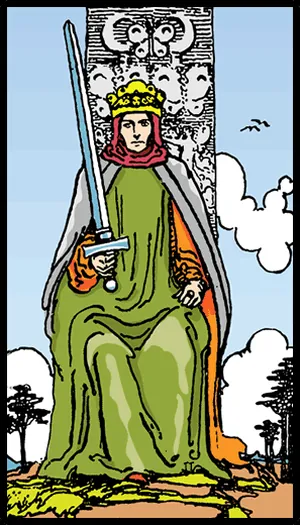
King of Swords description and symbolism
Facing the viewer squarely, a king sits on a plain stone throne with a long sword in his right hand, held upright but tilted a few degrees to his right, as if ready to lean either way before he rules. His tunic is blue, his cloak is purple, and he wears a simple cap under his crown. Butterflies and a crescent moon are carved into the back of the throne, and two small sylph-like figures appear near his head. The sky is mostly clear, with low clouds along the bottom and two birds flying together high above. A few trees stand in the distance.
Smith stripped this king of ornament on purpose. Where the Queen of Swords sits above clouds, the King sits in the open with the weather far below him, calm because he has decided how things will be. The slight tilt of the blade is the whole character: judgment is not rigid, it listens, and then it comes down on one side. The two birds, paired rather than solitary, hint at a mind that keeps counsel. Fire of Air is intellect with will behind it: the thought that becomes a rule, a verdict, a policy.
The King of Swords is authority through reason: the judge, the strategist, the person whose word is final because it was thought through before it was spoken.
King of Swords upright meaning
Pull the King of Swords upright and the reading calls for logic, structure and law. As a person, he is the judge, the surgeon, the senior lawyer, the professor, the strategist in the back of the room who says little and decides everything. He is fair, articulate, demanding of himself and others, and uninterested in excuses. He may be a man in your life with real authority over the matter at hand, or he may be the part of you that can set feeling aside long enough to decide correctly.
His message is to think it through and then commit. Gather the facts, consult the rule that applies, state the decision in plain language, and stand behind it. The King does not improvise and does not bargain with the truth. Where the Queen of Swords perceives, the King enforces. Beside Justice, legal or contractual matters resolve in favor of whoever has the stronger case. Beside the Emperor, two forms of authority meet, and the reading points to structure, hierarchy and rules being applied firmly. Beside the Ace of Swords, a new idea gets the discipline it needs to become a lasting decision.
King of Swords reversed meaning
Power without conscience is the King of Swords reversed. The same mind that upright serves truth now serves itself: manipulation, intimidation, legal threats, rules invented to control, intelligence used to humiliate. As a person, he is the boss who rules by fear, the partner who argues you into doubting your own memory, the official who enjoys the no. He is rarely loud. His cruelty is precise, and it comes dressed as reason.
Pointed inward, the reversal is either rigidity or its collapse. One version is a person so attached to being right that nothing new can get through, who treats every disagreement as a challenge to authority and every feeling as a weakness. The other is a mind that has lost its structure entirely: decisions put off, principles abandoned under pressure, clever arguments used to excuse what should not be excused. Either way, the sword has stopped serving anything larger than the ego. The Devil beside the reversed King names control and coercion outright. The Moon beside him says the clear thinker is being deceived, possibly by himself. Temperance restores the balance between the rule and the person it applies to.
King of Swords in love and as feelings
Romance with the King of Swords is a serious, honest, principled affair. He describes a partner who is reliable, intelligent and loyal, who shows love through protection and problem solving rather than words, and who will tell you the truth even when the truth is unwelcome. Couples pull him when a decision has to be made about the relationship and made with a clear head: a move, a commitment, a boundary with family, a conversation about money. Warmth exists under this card, but it is expressed in structure, not sentiment.
As feelings, the King of Swords means the person has thought carefully about you and reached a conclusion. They respect you, their intentions are clear, and they are unlikely to play games; the risk is that they intellectualize their emotions so thoroughly that you cannot tell how deep they go. Reversed in love, the warning is a controlling partner, emotional coldness used as punishment, or someone who rewrites arguments until you cannot remember what happened. For singles, the card points to a mature, somewhat reserved person, and to the importance of being clear about what you want before you meet them. With the Empress nearby, the King's reason and her warmth make a durable match.
King of Swords in career and money
In career matters, the King of Swords is the top of the profession: the partner at the firm, the chief of surgery, the judge, the department head, the consultant whose analysis settles the argument. He favors law, medicine, academia, engineering, policy, finance and any field where authority is earned through expertise. If he represents a person at work, he is a demanding, fair and formidable ally or opponent. If he represents you, the card says to lead with competence, document everything, and make the decision you have been circling.
With money, the King of Swords is methodical and honest. He reads the contract, understands the tax rule, and does not let charm substitute for numbers. The card favors structured planning, professional advice, and clean separation between business and personal finances. Legal and financial matters that need a ruling tend to resolve under this card. Reversed, it warns of a financial authority abusing trust, a contract drafted to trap you, or a decision made to prove a point. The Ten of Pentacles beside him turns good judgment into a legacy; the Seven of Swords beside him suggests somebody is being clever at your expense.
King of Swords in health and well-being
For health and well-being, the King of Swords is discipline and a clear mind. He is the energy of a person who sets a routine and keeps it, who approaches habits as decisions rather than moods, and who thinks before acting on an impulse. Mental sharpness is high under this card, and so is the risk of living entirely from the neck up: a tight jaw, shallow breath, a body ignored because the mind had other priorities.
The advice is to put the body on the agenda the way you would any serious matter. Plan rest the way you plan work, give the mind a structured outlet so it stops governing the night, and let logic include the fact that you are a physical creature. Reversed, the card points to rigidity that has become stress, self-criticism that has turned harsh, or control over food, sleep and exercise that has lost its humanity. Tarot can describe the mind's grip on the body; anything physical that worries you belongs with a doctor or other licensed professional.
King of Swords as a yes or no
Upright: Yes. The King of Swords upright is a yes, with conditions. The matter resolves in your favor if you handle it with logic, honesty and structure, and if your case is genuinely the stronger one.
Reversed: No. Reversed, the King of Swords says no. Control, manipulation or a rule applied without mercy is working against the outcome, and the situation will not improve until the power behind it changes hands or changes heart.
The card's advice
Sit in the open with the weather below you and decide. The King of Swords asks you to think the matter through, speak the ruling plainly, and keep the blade tilted just enough to show that the judgment listened before it came down.
Tarot card meanings are for entertainment purposes only and are not a substitute for professional advice.