Four of Swords description and symbolism
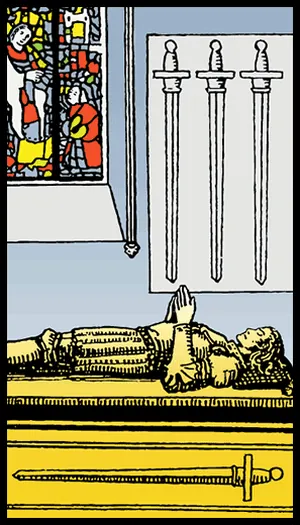
Inside a church, a knight in full armor lies flat on his back on a stone tomb, hands pressed together over his chest in prayer. One sword is carved into the side of the tomb beneath him, and three more hang on the wall above, points down. A stained-glass window in the upper left shows a woman and a child, haloed, with the word PAX worked into the glass. The light is gold and the stone is gray, and nothing in the room is moving.
The knight is not dead, and Smith left clues to say so: the hands in prayer are an active gesture, the armor is still on, and effigies on real tombs do not pray. He is resting the way a soldier rests between campaigns, in a sanctuary where nobody can reach him. The three swords on the wall are conflicts set aside, not resolved; the one on the tomb is the fight he is lying on top of. The window's PAX is peace granted by something larger than himself. Jupiter in Libra, the decan, is grace in the sign of balance, the mercy of an interval.
The Four of Swords is deliberate retreat: rest after struggle, recovery, contemplation, and the strategic pause that lets a mind stop before it breaks.
Four of Swords upright meaning
When the Four of Swords appears upright, you are being told to lie down. After a conflict, an illness, a loss, a hard stretch at work or a long argument with your own mind, the card prescribes rest, and it means real rest: withdrawal from the noise, time alone, sleep, prayer or meditation if those are yours, and a clear refusal to take up the swords again until you are ready. It often appears when someone has been pushing far past the point where pushing works.
The retreat is strategic rather than defeated. The knight keeps his armor on because he intends to return, and the pause is what makes the return possible. The card suggests that nothing important will be lost by stepping back for a while, and that the problem you are wrestling will look different after you have slept on it. Beside the Hermit, the solitude is the point and will yield insight. Beside Temperance, the recovery is a process of rebalancing and should not be hurried. Beside the Six of Swords, rest is followed by a move to calmer water.
Four of Swords reversed meaning
Reversed, the Four of Swords is the knight who will not lie down, or who cannot get up. The first version is burnout in progress: the signals to rest are being ignored, you are running on fumes and calling it dedication, and the body is about to make the decision for you. Restlessness, insomnia and the inability to stop thinking even in quiet rooms belong here. The second version is stagnation, a retreat that has gone on too long and become hiding.
There is a third and welcome reading, which is the end of the rest. The pause has done its work, energy is back, and it is time to take the swords down from the wall. Context decides. With the Ten of Wands beside the reversed Four, the overload is real and the collapse is close. With the Eight of Swords beside it, the retreat has become a prison of inaction. With the Knight of Swords beside it, you are rising fast and should make sure the recovery was actually complete.
Four of Swords in love and as feelings
For love, the Four of Swords describes a quiet interval. A couple takes a break from arguing, or from each other, and uses the space to think. A single person steps back from dating to recover from the last round. The card is not a breakup; it is a pause with an intention to return, and it tends to appear when the relationship has been through something and needs time to heal before anything is decided.
As feelings, the Four of Swords means the person is withdrawn and processing, not indifferent. They need space to work out what they feel, often because of a recent hurt, and pressing them for an answer now will only extend the retreat. For singles, the card suggests the right move is rest rather than pursuit, and that love will find a recovered heart more easily than a weary one. Reversed, a break has gone on so long it has become avoidance, one partner is burning out from carrying the relationship alone, or a period apart ends and two people come back to each other with fresh eyes.
Four of Swords in career and money
Career readings that produce the Four of Swords advise a pause. A vacation, a leave, a sabbatical, a weekend with the phone off, or simply stepping back from a project that has consumed you so you can think about it clearly. It appears before exams and big presentations as a reminder to rest the night before instead of cramming, and after conflicts at work as advice to let things cool before responding. A career decision made under this card should be made after the rest, not during it.
Financially, the Four of Swords is a holding pattern. Nothing much comes in or goes out, savings sit still, and the advice is to leave them that way for now rather than making moves from exhaustion. It can describe recovery after a financial hit, when the priority is stability rather than growth. Reversed, it warns of overwork for money that is costing your health, or of a financial pause that has slid into neglect. The Seven of Pentacles beside it says the investment just needs time; the Knight of Pentacles beside it says slow, steady work will restart things when the rest is over.
Four of Swords in health and well-being
Relief and the permission to stop are the Four of Swords' gift to health and well-being. The card is the deck's clearest instruction to rest: sleep, convalescence, a retreat, a weekend of nothing, time in a quiet place where nobody needs you. It appears when the nervous system is overloaded, during the days of getting over being run down, and whenever someone has mistaken constant activity for strength. Mental rest is as much the point as physical rest, and the card favors meditation, prayer, breathing and silence.
Its warning is the knight who refuses the tomb. Running on little sleep, skipping recovery, treating rest as weakness, and ending up forced to stop by the body. Reversed, the Four of Swords points to burnout, insomnia driven by a mind that will not quiet, or a recovery that has stalled into inertia. If you are recovering from something or cannot rest no matter how tired you are, that is a conversation for a doctor; the card can only tell you the rest is overdue.
Four of Swords as a yes or no
Upright: Maybe. The Four of Swords upright says maybe, and not yet. The situation calls for a pause before any answer, and the outcome improves if you rest and return rather than forcing a result now.
Reversed: No. Reversed, the Four of Swords leans no. Exhaustion or stagnation is shaping the question, and pushing ahead in this state is unlikely to bring what you want.
The card's advice
Lie down on the tomb with your armor on. The Four of Swords asks you to rest as a strategy, not a surrender, and to trust that the swords will still be on the wall when you are strong enough to need them.
Tarot card meanings are for entertainment purposes only and are not a substitute for professional advice.