Five of Swords description and symbolism
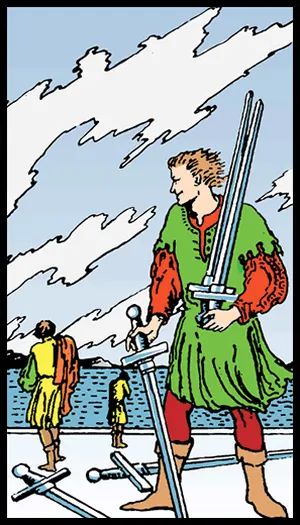
A young man with a sly expression stands in the foreground holding three swords, two in his left arm and one in his right, with two more lying on the ground at his feet. He looks over his shoulder at two figures walking away from him toward the water, one with head in hands, the other slumped and defeated. Behind them a gray sea lies under a sky of ragged, wind-torn clouds. The ground is flat and empty, and the winner's hair blows in the same wind that shreds the sky.
Smith painted a victory that nobody wants to be in. The man with the swords has won, and the picture refuses to make it feel good: the sky is torn, the losers are humiliated, and his smile is the smile of someone who has taken more than he can carry. Five swords for one man is too many, and two of them are already on the ground. The retreating figures still have their dignity in a way he does not. Venus in Aquarius, the decan, is affection made cool and detached, which is how conflict gets ugly: when caring about the other person stops.
The Five of Swords is conflict won at too high a price: defeat, hostility, winning by any means, and the empty aftermath of a fight that cost more than it gained.
Five of Swords upright meaning
Pulling the Five of Swords upright puts you in a fight, and the card asks which figure you are. You may be the one walking away, having lost an argument or a position to someone who played dirty, and feeling the particular sting of being outmaneuvered. Or you may be the one holding the swords, having won by being sharper or crueler than the moment called for, and now noticing that the people you beat were people you needed. The card covers bullying, office politics, a breakup fought to the last word, and any contest where being right became more important than being decent.
The teaching is about cost. A victory that leaves you alone on the beach with too many swords is not one the card celebrates. Before you press an advantage, the Five asks whether the thing you will win is worth the relationship you will lose. With the Seven of Swords beside it, the conflict involves deception and the win was not clean. With Justice, the dispute is heading toward formal resolution. With the Two of Cups, the fight is between people who love each other and will have to find a way back.
Five of Swords reversed meaning
Reversed, the Five of Swords puts the swords down. Someone apologizes, a grudge is released, two sides find a way to end a conflict without a final humiliation, and the wind in the sky starts to settle. It is the card of making amends and of choosing to walk away from a fight that cannot be won cleanly. People often draw it when they have decided that being at peace matters more than being proved right.
The reversal can also show resentment that refuses to leave. The fight is technically over and the loser is still replaying it, or the winner is still gloating, and the conflict goes underground where it does more damage. Old wounds from a betrayal can reopen under this card. Which reading holds depends on whether anyone has actually let go. With the Six of Swords beside the reversed Five, the move toward peace is real and involves leaving the battlefield. With the Nine of Swords beside it, the resentment is keeping someone awake. With Temperance, reconciliation is being worked out patiently and will hold.
Five of Swords in love and as feelings
Love readings that produce the Five of Swords describe a relationship at war. Arguments where the goal is to wound, one partner who always has to win, breakups fought over possessions and pride, and the specific cruelty of people who know each other's weak spots. It can also show a rival, a third party who takes what was yours, or a situation where you are being bullied or belittled by someone who calls it honesty.
As feelings, the Five of Swords means the person is in a competitive or defensive stance toward you, more concerned with protecting themselves or coming out ahead than with connection. There may be anger, resentment or a desire to settle a score. For singles, the card warns against dating anyone who treats romance as a contest, and it asks whether you are carrying a sword from a previous relationship into every new one. Reversed, a couple makes peace after a bad fight, an ex apologizes, or you decide to stop fighting a battle for someone's affection that you cannot win with dignity.
Five of Swords in career and money
Workwise, the Five of Swords is office warfare: a colleague who takes credit, a boss who humiliates, a negotiation won by intimidation, a promotion lost to someone who played politics better, or a toxic environment where everyone is hoarding swords. It can describe your own temptation to win a workplace battle by means you would not want described out loud. The card advises choosing your fights and remembering that the people you defeat today will be in the room tomorrow.
On money, the Five of Swords warns of financial conflict: a dispute over an inheritance, a business partner who takes more than their share, a lawsuit that costs both sides more than it settles, or a deal where you won and the other party will never work with you again. Reversed, the card points to settling a financial dispute, repaying what was taken, or walking away from a costly fight. The Ten of Pentacles beside it makes the dispute a family one; the Four of Pentacles beside it says greed is at the root of the conflict.
Five of Swords in health and well-being
High tension, high cost: for health and well-being, the Five of Swords describes the toll of conflict on the body. Adrenaline, clenched muscles, headaches after arguments, poor sleep spent rehearsing comebacks, and the drained, hollow feeling that follows a confrontation whether you won or lost. Chronic hostility, with others or with yourself, keeps the system in a fight it never gets to finish.
The advice is to drop at least two of the swords. Let an argument end, step out of an environment that is all competition, and give your body signals of safety: slow breathing, movement that is not about winning, time with people you are not keeping score against. Reversed, the card shows tension easing as a conflict resolves, or resentment that has settled into the body as a constant low hum. Physical symptoms that outlast the fight belong with a doctor; tarot reads the battle, not the bruises.
Five of Swords as a yes or no
Upright: No. The Five of Swords upright answers no. Even if you could force the outcome you want, it would come at a cost in trust or peace that the card does not consider worth paying.
Reversed: Maybe. Reversed, the Five of Swords gives a maybe. A conflict is winding down and reconciliation is possible, but the answer depends on whether everyone involved is willing to let the grudge go.
The card's advice
Count the swords before you pick up the fifth. The Five of Swords asks whether winning this fight will leave you standing on an empty beach, and it suggests that walking away with your dignity is sometimes the only real victory on offer.
Tarot card meanings are for entertainment purposes only and are not a substitute for professional advice.