Death description and symbolism
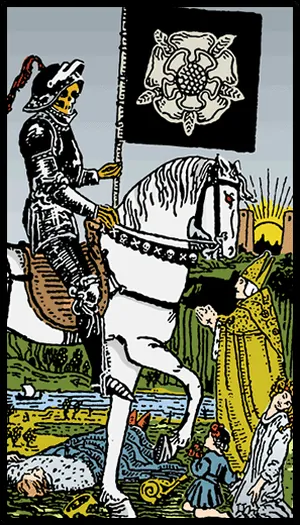
A skeleton in black armor rides a white horse across a field, carrying a black banner emblazoned with a white five-petaled rose. On the ground lies a dead king, his crown fallen beside him. A bishop in yellow robes stands with hands raised in prayer, a young woman turns her face away, and a child offers the rider a flower. In the background a river flows toward two towers, and between them a sun sits on the horizon.
Smith's Death is not frightening once you read the details. The horse is white, the color of purity; the rose on the banner is the mystic rose, life persisting through change. The king is dead because status does not negotiate with endings. The bishop prays, the maiden looks away, the child simply hands over a flower; three responses to the same event, and only the child's is free of fear. The river is the flow of life continuing, the boat on it carries the dead onward, and the sun between the towers is doing the thing the whole card is about: it could be setting or rising, and the picture refuses to tell you which.
The number thirteen and the skeleton made this the most feared card in the deck, but in a reading it almost never means physical death. It means an ending that is final, and a beginning that was impossible before it.
Death upright meaning
Death upright marks the definite end of something. A relationship, a job, a phase of life, an identity you have outgrown, a belief that no longer holds. Unlike the Tower, it is rarely a surprise; the thing has been dying for a while and the card simply confirms that it is over. What makes Death different from ordinary loss is that it carries the next chapter inside it. The ground cleared by this ending is where the new thing grows.
The card's demand is that you let go completely, not halfway. People who keep one hand on what is finished stay stuck in the in-between for years. Grieve what needs grieving, then turn toward the sun on the horizon and treat it as a sunrise. Death next to the Fool says the new beginning is immediate and open-ended. With the Ten of Swords, the ending has already happened and your only task is to stop reliving it. Beside the Star, the transformation leads somewhere gentle and hopeful.
Death reversed meaning
Reversed, Death describes an ending that is being refused. You know something is over and you are keeping it on life support: a relationship that ended emotionally months ago, a job you have quit in every way but the paperwork, a version of yourself that no longer fits but is familiar. The energy of the card reversed is stagnation, decay, a slow draining rather than a clean cut, and it is usually more painful than the ending itself would have been.
It can also describe fear of change so strong that you refuse to begin anything, because beginning implies an ending somewhere down the line. Sometimes the reversal is gentler: a transformation happening privately, slowly, without any outward drama, which can be fine as long as it is really happening. Beside the Four of Cups, the resistance has become numbness. With the Devil, you are clinging to a situation you know is harming you, and the card asks you to name what you are afraid of losing.
Death in love and as feelings
In love, Death upright most often means a relationship is ending or transforming so deeply that it will not be the same relationship afterward. For couples, that can be a breakup, but it can also be the end of a dynamic, the death of the honeymoon phase giving way to something more real, or the clearing of a pattern that was quietly killing the connection. For singles, the card asks you to let a past love go fully before anyone new can be seen clearly.
As feelings, Death means someone is going through a profound change in how they feel, about you or about love in general. Old feelings are dying and new ones have not fully formed; they may seem distant because they are in transition. Reversed, the card describes a relationship kept alive out of fear, a partner who will not let go of an ex, or a breakup that keeps being postponed. The Two of Cups appearing after Death suggests that the ending makes room for a far healthier bond.
Death in career and money
Workwise, Death means a job, a role or a business is ending, or that a way of working has run its course. A layoff, a resignation you have been considering, the closure of a project, a career that no longer matches who you have become. The card is not a prediction of failure; it describes a necessary close. People who draw Death in career readings are often at the point where leaving is the only honest option and staying would be the real loss.
Money under Death points to the end of a financial situation: a debt finally cleared, an income source stopping, a budget that must be rebuilt from scratch. Transformation here is practical: cutting what no longer serves, starting fresh. Reversed, the card warns about hanging on to a failing venture, delaying a necessary financial decision, or letting fear of change keep you in a job that is slowly costing you.
Death in health and well-being
Health and well-being under Death are about release and renewal. The card does not foretell illness; it describes the end of a habit, a pattern or a way of treating your body that has run its course. Quitting something, changing a long-standing routine, letting go of a self-image that kept you from caring for yourself. There may be a period of feeling depleted as the old pattern dies, followed by a return of energy that surprises you.
Emotionally, it governs grief and the strange lightness that follows it, and it asks you to make room for both. Reversed, Death points to stagnation: a habit you refuse to end even though it is draining you, exhaustion from carrying a chapter that is already closed. Clearing it out is the medicine. For anything beyond habits and energy, a doctor is the right person to ask; this card deals in transitions, not diagnoses.
Death as a yes or no
Upright: No. Death upright answers no, in the sense that what you are asking about is ending or changing beyond recognition. What comes after it may be the real yes.
Reversed: No. Reversed, Death also says no. The situation is stuck between ending and beginning, and until you release what is finished, nothing new can start.
The card's advice
Let what is over be over, and grieve it properly instead of pretending it is still alive. Death reminds you that every ending clears the ground, and that the sun on the horizon is rising if you choose to face it that way.
Tarot card meanings are for entertainment purposes only and are not a substitute for professional advice.