The Hierophant description and symbolism
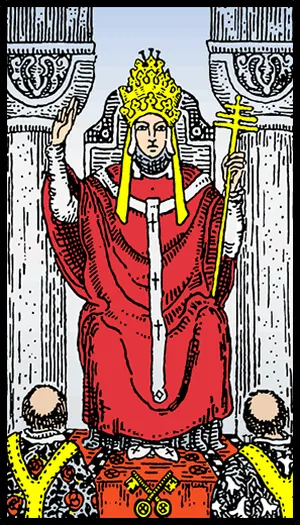
A robed figure in red sits on a throne between two gray stone pillars, raising his right hand in blessing with two fingers up and two folded. His left hand holds a tall staff topped with a triple cross. On his head sits a three-tiered crown, and at his feet two crossed keys lie on the floor. Before him kneel two tonsured monks, one in a robe decorated with red roses and the other with white lilies.
The scene is a formal ceremony and that is the message. The three-tiered crown and the triple cross mark three levels of authority, spiritual, intellectual and material, and the raised hand is a traditional gesture of benediction that also hints at the visible and the hidden, two fingers shown, two concealed. The crossed keys are the keys to doctrine, the knowledge that is passed down through tradition rather than discovered alone. The two monks repeat the roses and lilies from the Magician's garden, passion and purity, now submitting to instruction. Where the High Priestess kept her scroll half-hidden, the Hierophant teaches openly, through institutions, rituals and rules.
Smith made him look less like a mystic and more like a pope, which was the point. This card is organized belief, the wisdom of the group, and the comfort and the limits that come with it.
The Hierophant upright meaning
The upright Hierophant points you toward the established way of doing things. There is a tradition, a method, a mentor or an institution that already knows how to handle what you are facing, and the card suggests you use it instead of improvising. Formal education, religious or spiritual communities, professional bodies, marriage, legal processes and anything with an official stamp fall under his staff. Going through the proper channels may feel slow, but right now it is the path that holds.
He is also a teacher card. Someone with more experience is available to guide you, and the Hierophant asks you to be humble enough to learn. Equally, you may be the one with the knowledge, and the card is asking you to pass it on properly. The deeper theme is belonging: the comfort of shared values, the sense that you are part of something larger than your own preferences. The Hierophant beside the Lovers often points to a wedding or a formal commitment. Beside the Three of Pentacles, it describes learning a craft within a structure that respects it.
The Hierophant reversed meaning
Reversed, the Hierophant is the student walking out of the lecture. The rules you inherited no longer fit, the institution you trusted has disappointed you, and you are ready to think for yourself even if that means standing alone. Sometimes this is healthy and overdue: a belief system that was handed to you deserves to be examined before you keep carrying it. The card often appears when someone is leaving a religion, a profession, a family expectation or a conventional path that was never really theirs.
The reversal has a darker side, though. It can describe a teacher who misuses their authority, a group with rigid dogma that punishes questions, or a person who rejects every tradition on principle and ends up with nothing to stand on. Rebellion that has no idea what it wants to build is just another kind of conformity. Ask what you actually believe, not what you are against. When the Hierophant reversed appears with the Fool, you are being invited to find your own way, and the invitation is real.
The Hierophant in love and as feelings
In love, the Hierophant upright is one of the deck's clearest commitment cards. It points to marriage, engagement, meeting the family, or any step that makes the relationship official in the eyes of others. The connection is built on shared values and on wanting the same kind of life rather than on pure chemistry, and that is its strength. For singles, the card may bring a traditional person, someone who wants to do things properly, or a meeting through a community, class or place of worship.
Read as feelings, the Hierophant means someone sees you as a serious prospect. They are thinking in terms of the long run, of whether you would fit into their world and their plans, and their feelings are respectful rather than reckless. Reversed, the card describes a couple whose values no longer match, pressure from family or religion that strains the bond, or a relationship that is stuck in convention and has lost its spark. Next to the Two of Cups upright, the Hierophant suggests a partnership that is both deeply felt and ready to be made official.
The Hierophant in career and money
Workwise, the Hierophant favors established organizations, formal qualifications and clear career ladders. Teaching, law, medicine, religious work, government, academia and large corporations all carry his energy. If you are deciding between a safe institutional role and a wild independent venture, the card points to the first, at least for now. It also suggests finding a mentor inside your field and following the recognized route to advancement rather than trying to skip steps.
Money under the Hierophant is conservative. Traditional savings, pensions, advice from a licensed professional, following the rules of the system. It is not the card for speculative investments or get-rich-quick ideas. Reversed, he describes an institution that is failing you, a qualification that no longer opens doors, or the realization that the conventional path to financial security is not the only one and that your own approach deserves a chance.
The Hierophant in health and well-being
In terms of health and well-being, the Hierophant is the card of tried and tested wisdom. It favors routines handed down over generations, the kind of advice your grandmother gave, regular rhythms, community rituals like a weekly shared meal or a walking group, and practices with a long tradition behind them such as yoga, prayer or simply going to bed at a sensible hour. Structure and belonging are good for you right now; isolation is not.
Reversed, the card can describe someone who has rejected all guidance and is improvising with their body, or the opposite, a person following rules so rigidly that they have stopped listening to how they actually feel. Either way, balance comes from pairing good counsel with honest self-observation. If a physical concern is behind your question, a licensed doctor is the tradition to trust; tarot reflects your attitude toward care, not your clinical state.
The Hierophant as a yes or no
Upright: Yes. Upright, the Hierophant answers yes, as long as you take the conventional route. Follow the established process and the doors open in order.
Reversed: No. The Hierophant reversed tends toward no. The rules in play do not serve you, or you are breaking them in a way that will cost more than it gains.
The card's advice
Learn from those who walked this road before you, and respect the structures that still hold. The Hierophant asks you to honor tradition while staying honest about which beliefs are truly yours.
Tarot card meanings are for entertainment purposes only and are not a substitute for professional advice.