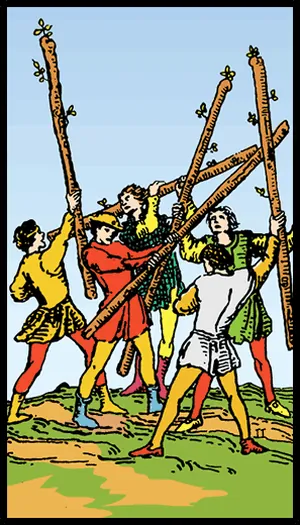
Five of Wands description and symbolism
Five young men in mismatched tunics swing long staves at one another on open ground under a blue sky. No one is bleeding, nobody is on the ground, and if you look closely, the wands do not actually connect; they cross in the air like a tangle of sticks. Each figure wears a different color and pattern, and each seems to be fighting his own fight without any shared target. There is no castle, no water, no horizon, just the scuffle.
Smith drew a brawl that is more noise than damage, and that is the whole reading. The five are not enemies; they are rivals, teammates or siblings working out who leads, and the energy is heated but not cruel. The clashing colors say five different wills are in play with no agreement on the rules. Saturn in Leo, the decan of this card, puts a cold, structuring planet in the sign of pride, which is why the struggle is about ego and position more than survival.
The Five of Wands is competition, disagreement and the friction of too many strong opinions in one room. It is uncomfortable, it is sometimes productive, and it rarely draws blood.
Five of Wands upright meaning
Pulling the Five of Wands upright means you are in a crowd of competing wills. At work it is the meeting where everyone talks and nothing is decided; at home it is a family where each person has a plan and none of them match; in your own head it is five good ideas fighting for the same afternoon. The card describes friction, not catastrophe. Nobody is trying to destroy you, but everybody wants their way, and the result is wasted energy and a lot of shouting.
The useful side of the Five is that competition sharpens. Rivalry can push you to do better work, a heated debate can expose a weak plan before it costs money, and a sparring partner is a gift if you treat the fight as training. The card's advice is to stop swinging at everyone and figure out what you are actually trying to win. Beside the Six of Wands, the contest ends with you on top. Beside Justice, the dispute needs a referee, perhaps a mediator or a clear set of rules. Beside the Five of Swords, the fight has turned personal and someone will walk away hurt.
Five of Wands reversed meaning
Often the fight is ending when the Five of Wands shows up reversed. The group finds common ground, a rival becomes a colleague, or the thing everyone argued about gets settled and the energy that went into bickering goes back into the work. After an upright Five in a previous reading, the reversal is good news: the sticks come down.
It has a second face. The reversed Five can mean conflict that goes underground. You avoid the confrontation, swallow the disagreement, keep the peace at the cost of your own position, and the tension turns inward as irritability or self-doubt. Inner conflict is a frequent reading here: wanting two things, being torn between loyalties, or arguing with yourself in a loop. When the Five of Wands reversed appears next to the Two of Swords, the avoidance has become a stalemate. Next to Temperance, the peace is real and worth protecting.
Five of Wands in love and as feelings
In love, the Five of Wands brings bickering, competition for attention, or a stretch where you and a partner cannot agree on anything from dinner to the future. The arguments tend to be about ego and control rather than deep betrayal, and many couples draw this card during a stressful season when both people are tired and short-tempered. It can also point to rivals: more than one person interested in the same partner, or a love triangle that nobody has named out loud.
As feelings, the Five of Wands means the person is conflicted about you. They are attracted and resistant, interested and competitive, or they feel pulled between you and someone or something else. It can also show that they experience the relationship as a contest, always keeping score. For singles, the card describes a crowded field: dating that feels like competing, many options and no clear favorite, or a flirtation that stays at the sparring stage. Reversed, a couple finally stops fighting, a triangle resolves, or someone decides to stop competing and simply be honest.
Five of Wands in career and money
Professionally, the Five of Wands is the office with too many voices. Rivalry for a promotion, a team that cannot agree on direction, clashing egos in a project, or a market full of competitors chasing the same customers all fall under it. Job seekers draw the card when the posting has hundreds of applicants and the interview feels like a contest. The news is not bad: competition means the prize is worth having. The card asks you to compete on skill rather than on volume, and to make sure your own team is not fighting itself.
In money matters, the Five of Wands warns about energy and funds spread across too many fronts. Several small ventures, several arguments about the household budget, several people wanting a say in how savings are used. Consolidate, agree on the rules, then act. Paired with the Three of Pentacles, the chaos turns into productive teamwork; paired with the Seven of Wands, you will have to defend your position to keep what you earned.
Five of Wands in health and well-being
For health and well-being, the Five of Wands reads as scattered, agitated energy. Too many demands at once, a schedule that never settles, stress that shows up as irritability, tight shoulders and poor sleep. People under this card often feel wired rather than tired, and the restlessness looks for an outlet, sometimes in arguments with the nearest person. Competitive exercise, sports or anything that lets the body spend the fire without aiming it at other people tends to help.
The deeper advice is to reduce the number of fights you are in. Decide what matters this week and let the rest wait, because a mind arguing with itself all day exhausts the body just as surely as hard labor does. Reversed, the card points to tension that has been bottled up and needs a safe release: movement, talking it out, or simply naming the conflict. Any physical symptom that persists belongs with a doctor, not with a card.
Five of Wands as a yes or no
Upright: Maybe. The Five of Wands upright answers maybe. You can get what you are asking about, but only by competing for it, and the outcome stays uncertain until the dust settles.
Reversed: Yes. Reversed, the Five of Wands leans toward yes. The friction around the question is easing, and once the arguing stops the path to what you want opens up.
The card's advice
Put the stick down long enough to ask what the fight is about. The Five of Wands rewards people who turn rivalry into better work and refuse to waste their fire on battles that have no prize.
Tarot card meanings are for entertainment purposes only and are not a substitute for professional advice.